
Lost & Driven · Case 001
The Car That Taught Me Cars Were Cool
One primer-gray 1969 Chevelle, last seen in northeast Minneapolis, drove off with a piece of a five-year-old and never gave it back. This is the search to find it.
The case, in the founder's words.
Case 001 belongs to Michael Kraabel, and he opens the programme with the car that started his. The letter below is the full case file: the memory, the history, and the plan.
With Audie Murphy, in the window between 1979 and 1986. No confirmed sighting has been logged since.
The Gray Chevelle
Lost & Driven · Case Nº 001 · Founder's Letter *By Michael Kraabel, Founder, Autodyssey*
Nobody has ever fallen in love with a car because of its specifications.
I know the spec sheet is fun, and I can spend a happy evening arguing whether the L78 made a true 375 horsepower or whether Chevrolet's marketing department was enjoying a long lunch that day. The spec sheet is the paperwork of love, filed long after the fact, the way a marriage certificate explains nothing about the night you met.
Love arrives at street level instead, and it arrives early. You are five years old, you could not identify a carburetor if it fell on you, and a gray car comes around the corner and rearranges your entire personality. Mine came around a corner in northeast Minneapolis at the end of the 1970s, and it belonged to a young man named Audie Murphy, who was dating my mother.
The timing matters, because Detroit had spent that decade holding a funeral for horsepower, with the insurance men, the smog pumps, and the federal 55 limit serving as pallbearers. The new showrooms sold stripes where the compression used to be, every kid on my block wanted Burt Reynolds's black Trans Am, whose most powerful component was the bird on the hood, and the corner station had spent 1979 making grown men line up for the privilege of paying more for gas. A 1969 Chevelle from the good years rumbled through all of it like a rumor the decade had failed to kill.
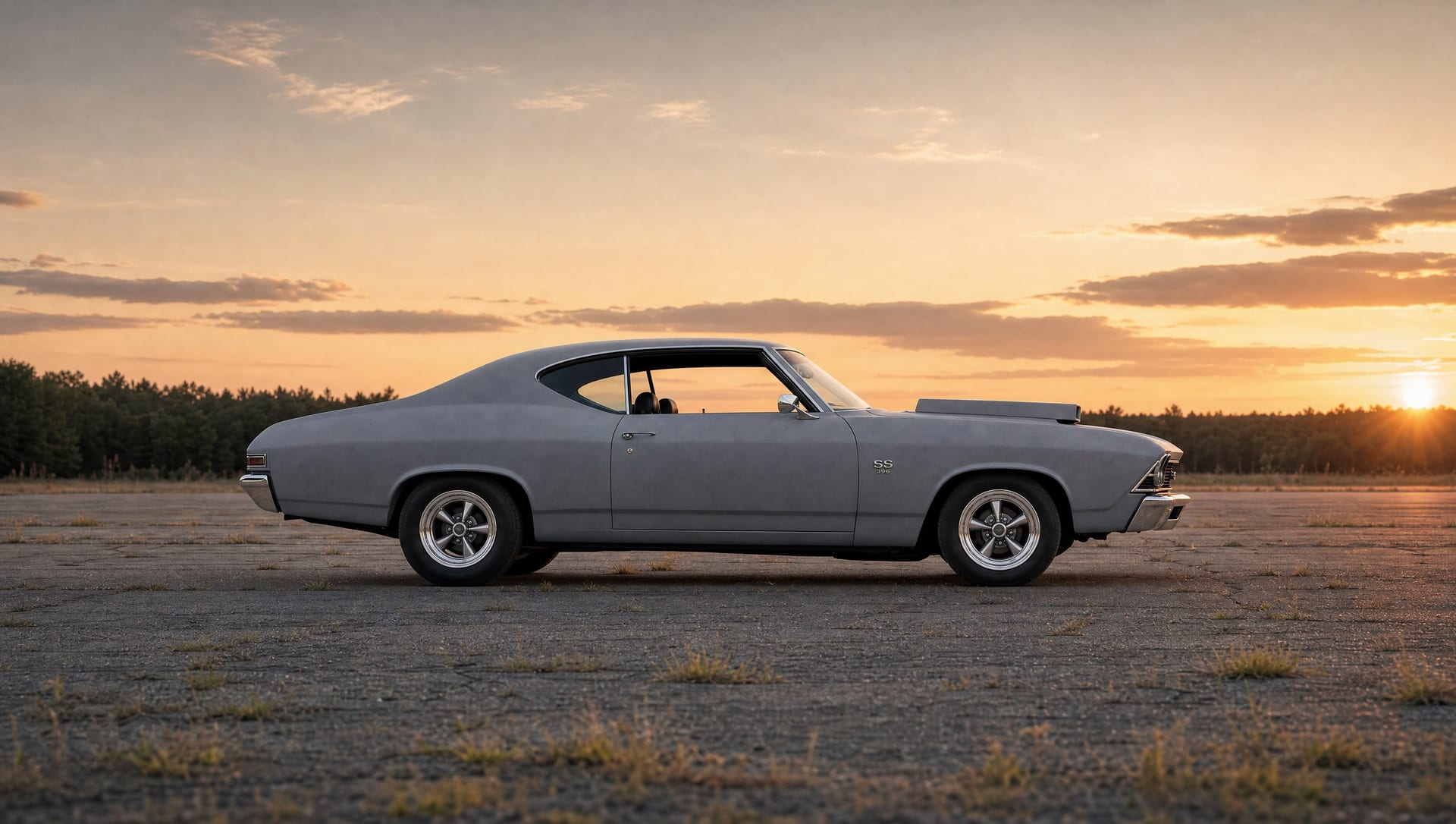
The car wore nothing but primer, which I assumed as a child was a color, and which I now understand is the automotive equivalent of arriving at a black-tie dinner in a bathrobe and being the best-dressed person in the room. A big block sat under a raised scoop that split down the middle and stood off the hood like it was daring the sky to try something, the tail rode high on wide rear rubber, the mag wheels caught what little sun Minnesota issues, and the whole machine looked permanently annoyed that anyone expected it to obey the new speed limit.
I understood none of this and had no vocabulary for any of it. I only knew, the way small children know things, that the car operated on a different frequency than the Pintos and Country Squires parked along our block, and that Audie, who was carefree in a way adults generally are not, had somehow been issued the keys to it.
Then one afternoon made the whole thing permanent. My folks came to get me from school and parked the Chevelle across the ditch culvert that ran along the edge of the playground, and every kid in the yard stopped and filled the fence to ask whose car it was. I walked across that culvert like a man being knighted, in front of an entire playground of children who had just agreed, unanimously and without debate, that the thing I loved was cool. I have spent nearly fifty years since then failing to recapture that feeling, and I would like the record to show that I am not cool today, because I am a man who gets excited about archival indexes. I was the most important person in the state of Minnesota for about ninety seconds in 1979 or 1980, and a gray Chevelle did that for me.
Case History
Audie died young, and I was small enough that the details went past me, the way details do when you are five. His family lived in northeast Minneapolis, he dated my mother somewhere in the window between 1979 and 1986, most likely 1979 or 1980, and the trail goes quiet before that window closes. The memory leaves me a shape, a color, a sound, and a stance, and the case file starts there.
The shape itself tells a researcher where to look. Chevrolet sold the 1969 Chevelle in enormous numbers, and the Super Sport package sat at the top of the order sheet with a 396 in three states of tune, so SS badges on a primer car prove ambition and nothing else. A raised dual-split scoop was a builder's choice rather than a factory option, wide rear rubber under a lifted tail says the car was set up to launch, and a launch-ready big block in that city in those years points at the local strip. Minnesota Dragways ran in Anoka through those years, the Gopher State Timing Association ran the scene around it, and both left crowds, timing slips, and photo archives that can still be searched. A car built that loudly got noticed, which means somebody photographed it, and a photograph with a plate in frame would move this case farther than anything else in the file.
The name is the hard part. Audie Murphy is also the most decorated American soldier of the Second World War and a working actor who died in May 1971, so every plain search for the name returns him instead of a young man from northeast Minneapolis. Getting past the famous Audie takes an address, a middle name, family names, or an exact death year, and my mother holds most of those keys. Her interview opens the file: full name and spelling, dates, where he worked, the car's plates and true color, and any photograph that survived in a drawer.
The Search Plan
The method is ordinary record work, run in order and in public. The death index at the Minnesota Historical Society fixes identity and dates, obituaries in the Minneapolis papers add family names and sometimes a photograph, and Hennepin County probate can carry the one number that opens everything else, because an estate inventory that lists a car lists its VIN. City directories place the household on a block, the genealogy stacks find living relatives who may know where the car went, and the Chevelle registries turn thousands of people who notice these cars into spotters. A title-history request goes to the state under a permitted use the moment a VIN surfaces, and that paperwork lands in this file next to everything else.
Why Lost & Driven Exists
Autodyssey holds one belief that borders on stubbornness: a car outlives every person who owns it, and the record is the only thing that carries it forward, because memory dies with the rememberer and paper does not. We built the Vault to hold what is true about a vehicle, the Provenance Score to measure how complete that truth is, and the Passport to prove it to a stranger in ninety seconds. Lost & Driven starts one chapter earlier, at the moment a car goes missing from somebody's life.
Maybe you built the car in a garage with your dad and it sold during a hard year, or it belonged to your grandmother and the family lost track of it after the funeral, or, like me, you never owned it at all and it still became part of your operating system. We find those cars. Sometimes the search ends in ownership, and more often it ends in something quieter and every bit as good, which is knowing where the car went, who holds it now, and that it survived.
I am going first on purpose, because a method that can find one gray Chevelle a kindergartner loved for a single afternoon can find nearly anything anybody lost. Every record we pull, every dead end we hit, and every person who writes in to say they remember the car lands on this page as we go.
The SS Question
One wrinkle in this case earned its own heading. Chevrolet sold the 1969 Super Sport as option code Z25 and never stamped that code into the VIN, so the number on the car proves the year, the plant, and its place in the production run while saying nothing about whether the SS is real. Proof lives on the cowl tag and in the paper trail, and assembling that proof takes a stubborn person. I have the stubborn part covered.
If you knew Audie Murphy of northeast Minneapolis, or you remember a primer-gray Chevelle sitting high on its back tires around 1979 or 1980, the tip line waits at the bottom of this page and I would love to hear from you.
Let's go find it.
The case, slide by slide
The founder walks the case here the way he would across a garage floor. Use the arrows or your keyboard to move through it.
 Reconstruction
The Case
A primer-gray 1969 Chevelle disappeared from northeast Minneapolis around 1980, and I have carried the memory of it ever since. These slides present the case the way I would across a garage floor: the car, the man who drove it, the afternoon that mattered, and the plan to find it.
What the memory holds
Every detail below comes from a five-year-old's memory, which is why each carries a confidence level. The interview with the founder's mother will firm these up.
Fifty years, one afternoon confirmed.
The record is one schoolyard memory and a set of open leads. The entries outlined in brass are the ones a tip could fill in.
- · ConfirmedThe car
A 1969 Chevelle, primer gray, big block, raised dual-split scoop, mag wheels, wide rear rubber, drag stance, chrome bumpers front and rear, wearing SS badges.
- · ConfirmedThe keeper
Audie Murphy, a young man who dated the founder's mother, whose family lived in northeast Minneapolis.
- · ConfirmedThe window
He died young, somewhere between 1979 and 1986, most likely 1979 or 1980. The founder was about five or six at the schoolyard pickup.
- · ConfoundThe name collides with a legend
Audie Murphy is also the most decorated American soldier of the Second World War and a working actor who died on 28 May 1971. Every plain search for the name returns him. Getting past it takes a northeast Minneapolis address, a middle name, family names, or an exact death year.
- · Open leadThe interview
The founder's mother is the richest single source in this case. Full name and spelling, dates, family, where he worked, the car's plates and true color, and any photograph.
- · Open leadDeath index and obituaries
Run the name through the Minnesota Historical Society death index and the Minneapolis papers across 1977 to 1987 to fix identity and dates.
- · Open leadHennepin County probate
An estate inventory can list a car and carry its VIN, which is the number that opens everything else.
- · Open leadThe racing trail
A drag-stanced big block may well have run Minnesota Dragways in Anoka, active through the 1960s and 1970s, and the Gopher State Timing Association ran the local scene. Both offer crowds to canvass and photo archives to search.
- · Open leadThe enthusiast network
Post the description to the Team Chevelle registry and place a seeking ad in the classifieds. Thousands of people who notice Chevelles become spotters overnight.
- · Open leadMinnesota title history
Ready to file the moment a VIN surfaces, routed through a permitted use under the Driver Privacy Protection Act and logged in this file with the paperwork.
Where the paper leads
The archives, indexes, and registries the search works through, in order, with the status of each.
The Memory Banks
Nobody photographed the car while it was here, so these frames come out of the memory banks instead. The Autodyssey AI Way Back Machine takes a keeper's earliest memory of the car that hooked them and reconstructs what they saw, detail by remembered detail. Every frame below is a reconstruction rather than a document, and every frame is labeled as one. The car is real, the memory is real, and the photographs never existed until now.
A free account puts you on the case.
- Follow the story as the search develops
- Post leads and comments to the case log
- Edit or delete anything you have posted
- Add photographs to the case file
- Turn on email alerts for new developments
0 members follow this case.
The log is empty. The first lead starts the record.
Remember this car?
If you knew Audie Murphy of northeast Minneapolis, or you remember a primer-gray Chevelle sitting high on its back tires around 1975, this form goes straight to the founder. Tips can be anonymous, and no tip is too small.